In short
- Emperor Leopold I vowed a new church here in the plague year 1679; it was consecrated on 17 May 1733.
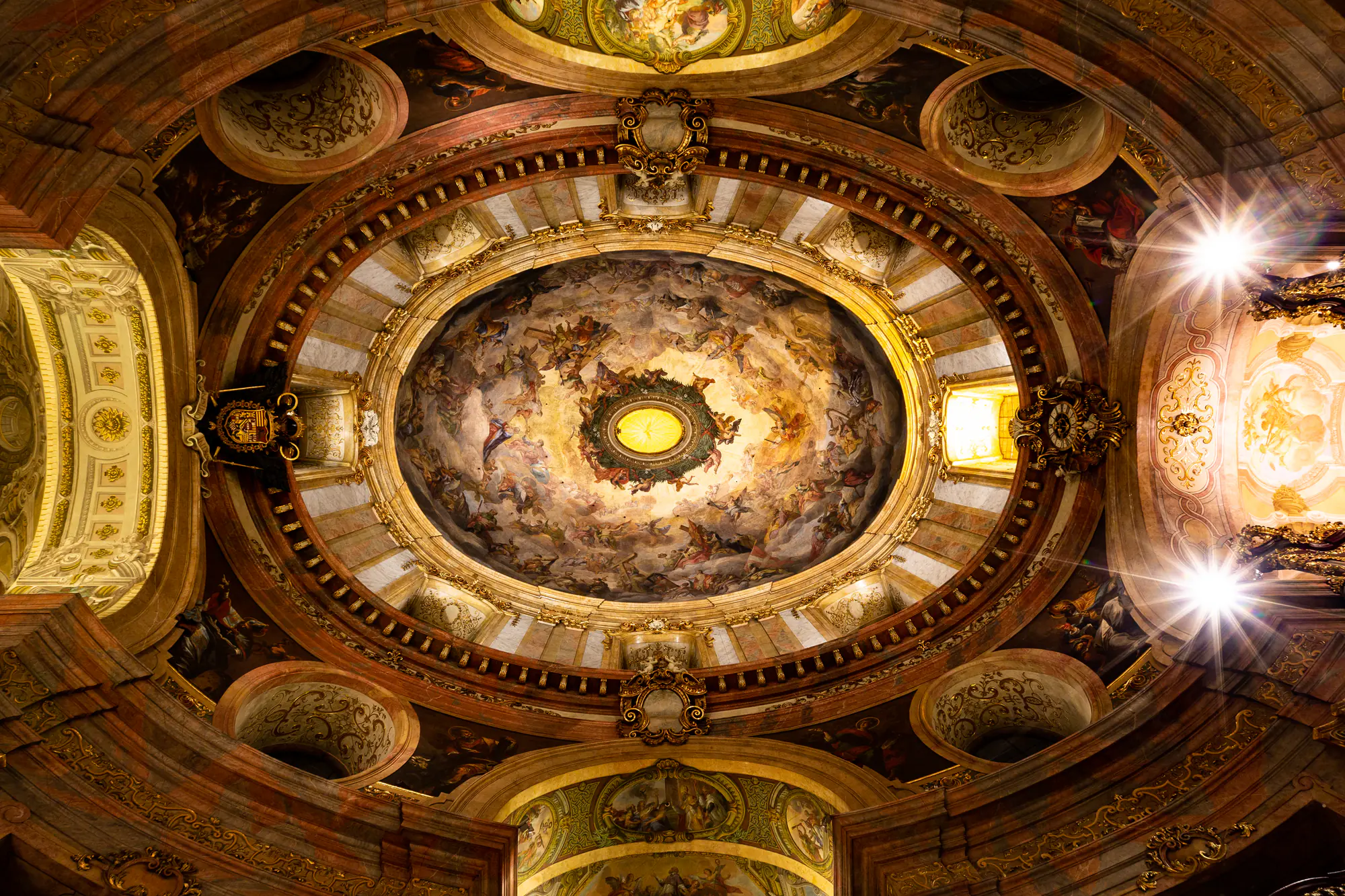
- Johann Michael Rottmayr painted the dome in 1713 and 1714.
- Mass is said every day: the concerts are played in a working church.
Before the Baroque
A church has stood here since at least the eleventh century, and in 1137 it was placed under the parish of St Stephen’s. By the church’s own tradition, Vienna’s first Christian church stood on this spot in Roman Vindobona, and a legend has Charlemagne founding it in 791: Rudolf Weyr’s relief of 1906 on the east wall shows the scene.
A plague vow and a small St Peter’s
In 1679, a plague year, Emperor Leopold I vowed to replace the old church; an inscription at the main door records the vow. The Brotherhood of the Holy Trinity, a fraternity of wealthy citizens and nobles, paid for a new building meant to recall St Peter’s in Rome.
Leopold I laid the foundation stone in 1702. The design is usually credited to Gabriele Montani, carried on and changed by Johann Lukas von Hildebrandt. Rottmayr painted the dome in 1713 and 1714, the choir followed from 1730, and Cardinal Kollonitsch consecrated the church on 17 May 1733.
What to look for
Above you, Rottmayr’s fresco of the Virgin taken up into heaven. At the front, the high altar designed by Antonio Galli-Bibiena, with Martino Altomonte’s painting of Peter and John healing a lame man. To one side, Matthias Steinl’s pulpit; facing it, a gilded group of St John Nepomuk thrown from the bridge in Prague. Behind you, the organ case of 1751.
The church today
St Peter’s became a parish in 1783, and since 1970 it has been in the care of priests of Opus Dei. Mass is said every day. In the evening Classic Ensemble Vienna plays at the front of the nave, and the audience sits in the pews.
Sources: Vienna’s city history wiki, “Peterskirche”; the ensemble’s own information about the church.