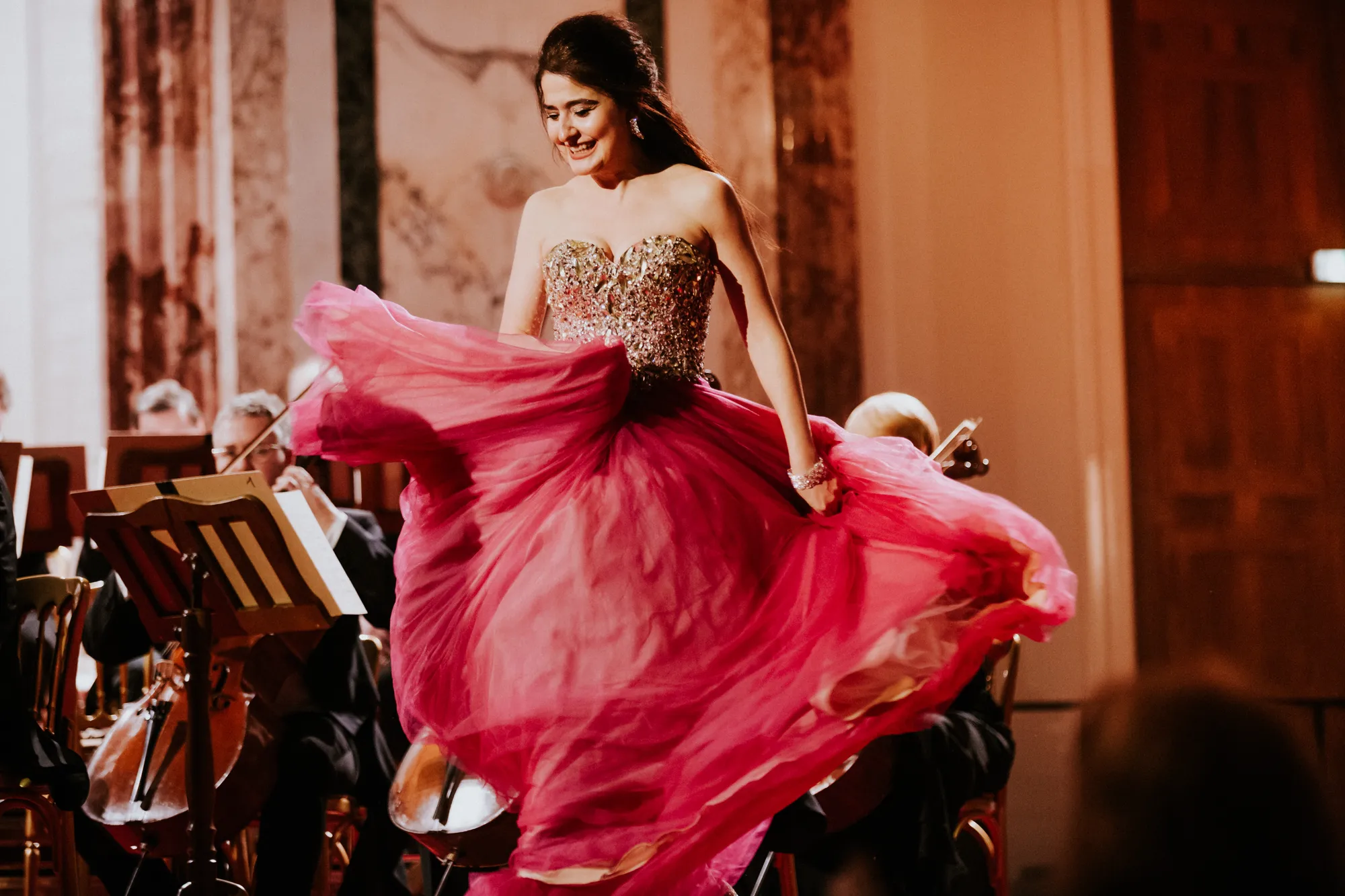
In short
- About ninety minutes, played by about forty musicians.
- Each evening is chosen from this repertoire, so single works change from night to night.
- The Blue Danube and the Radetzky March close the night.
From the repertoire
- Franz von Suppé, 1819–1895
The Beautiful Galatea, overture
Die schöne GalathéeFrom Suppé’s operetta about a sculptor whose statue comes to life.
- Josef Strauss, 1827–1870
Fireproof!, polka
Feuerfest!, Op. 269Written for a Viennese maker of safes, with an anvil among the percussion.
- Wolfgang Amadeus Mozart, 1756–1791
The Marriage of Figaro: “Non più andrai”
Le nozze di Figaro, K. 492Figaro sends the young page Cherubino off to the army.
- Wolfgang Amadeus Mozart
Don Giovanni: “Non mi dir”
Don Giovanni, K. 527Donna Anna asks Don Ottavio not to call her cruel.
- Johann Strauss II, 1825–1899
Artist’s Life, waltz
Künstlerleben, Op. 316A waltz first played in 1867, the same month as the Blue Danube.
- Emmerich Kálmán, 1882–1953
The Csárdás Princess: “Tanzen möcht’ ich”
Die CsárdásfürstinThe waltz duet from Kálmán’s operetta, first staged in Vienna in 1915.
- Franz Lehár, 1870–1948
The Merry Widow: “Lippen schweigen”
Die lustige WitweThe waltz duet from Lehár’s operetta, first staged at the Theater an der Wien in 1905.
- Johann Strauss II
Viennese Blood, the duet
Wiener BlutFrom the operetta made of Johann Strauss’s own waltzes, first staged in 1899, the year of the composer’s death.
- Johann Strauss II
The Blue Danube
An der schönen blauen Donau, Op. 314First heard in Vienna in 1867, and the city’s unofficial anthem since.
- Johann Strauss I, 1804–1849
Radetzky March
Radetzky-Marsch, Op. 228Written in 1848, and the march that ends the Vienna New Year’s Concert, the audience clapping along.
Sources: The orchestra’s own published repertoire; the history of each work from the standard reference works.