In short
- About ninety minutes.
- Each evening is chosen from this repertoire, so single works change from night to night.
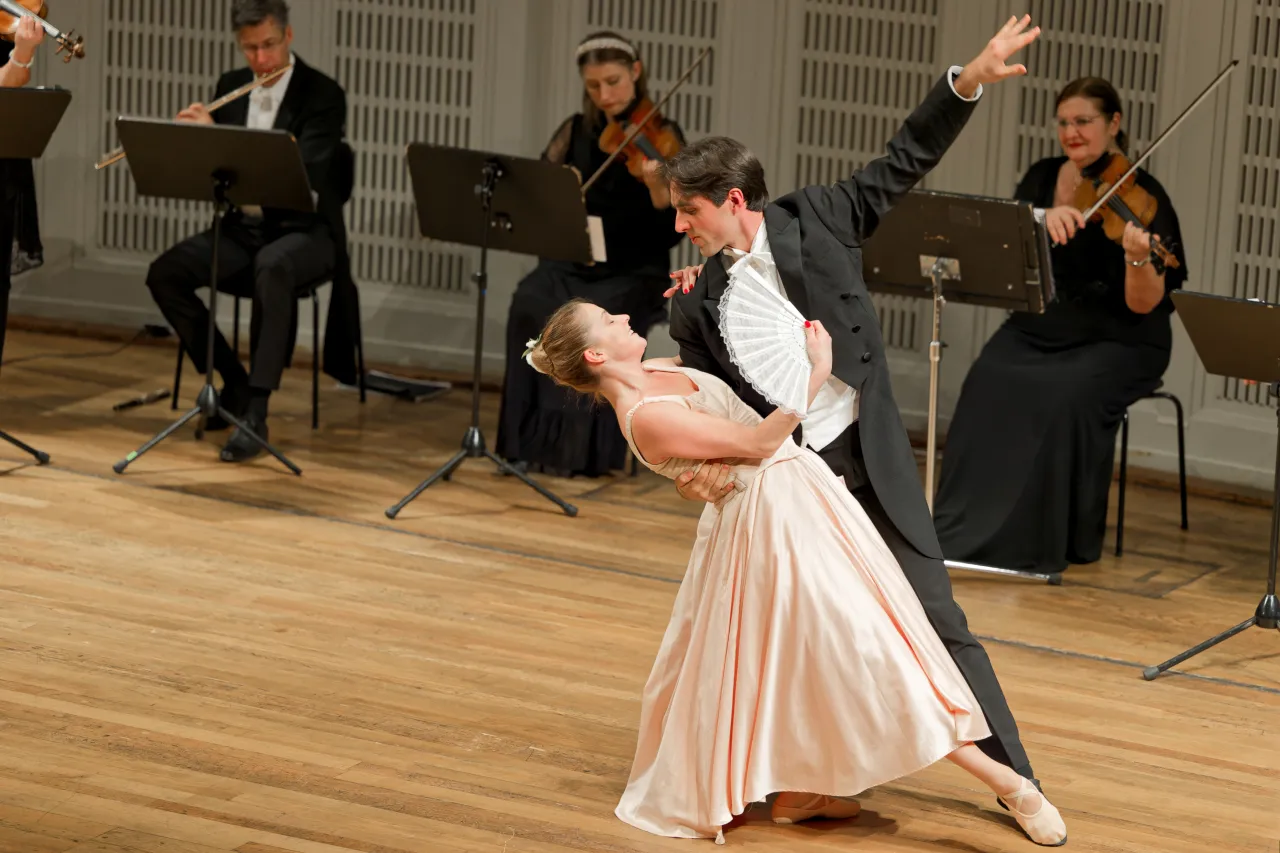
- Opera singers take the arias and duets, and two ballet dancers in period costume join several numbers.
From the repertoire
- Wolfgang Amadeus Mozart, 1756–1791
The Marriage of Figaro, overture
Le nozze di Figaro, K. 492First heard at the Burgtheater in Vienna in 1786. In about four minutes it races through the whole mad day of the opera that follows, which makes it the classic way to open an evening.
- Joseph Haydn, 1732–1809
Symphony No. 1 in D major
Hob. I:1The first of Haydn’s 104 symphonies, written around 1759.
- Wolfgang Amadeus Mozart
Don Giovanni: “Là ci darem la mano”
Don Giovanni, K. 527Don Giovanni charms the bride Zerlina on her wedding day.
- Wolfgang Amadeus Mozart
The Magic Flute: the “Pa-pa-pa” duet
Die Zauberflöte, K. 620Papageno finds his Papagena at last, and the two stammer out each other’s names.
- Ludwig van Beethoven, 1770–1827
Romance No. 2 in F major for violin and orchestra
Op. 50A slow, singing piece for solo violin, published in Vienna in 1805.
- Antonio Vivaldi, 1678–1741
The Four Seasons, a movement
Four violin concertos printed in Amsterdam in 1725, each with a sonnet about its season. Vivaldi died in Vienna in 1741.
- Johannes Brahms, 1833–1897
Hungarian Dance No. 5
Written for piano four hands and the best known of Brahms’s twenty-one Hungarian Dances. It speeds up and slows down without warning.
- Johann Strauss II, 1825–1899
Die Fledermaus: “Mein Herr Marquis”
The BatThe chambermaid Adele, at a ball in her mistress’s dress, laughs off the man who thinks he knows her.
- Johann Strauss II
Chit-Chat Polka
Tritsch-Tratsch-Polka, Op. 214A fast polka of 1858 about Viennese gossip.
- Johann Strauss II
Viennese Blood, the duet
Wiener BlutFrom the operetta made of Johann Strauss’s own waltzes, first staged in 1899, the year of the composer’s death.
- Johann Strauss II
The Blue Danube
An der schönen blauen Donau, Op. 314First heard in Vienna in 1867, and the city’s unofficial anthem since.
- Johann Strauss I, 1804–1849
Radetzky March
Radetzky-Marsch, Op. 228Written in 1848, and the march that ends the Vienna New Year’s Concert, the audience clapping along.
Sources: The orchestra’s own published repertoire; the history of each work from the standard reference works.