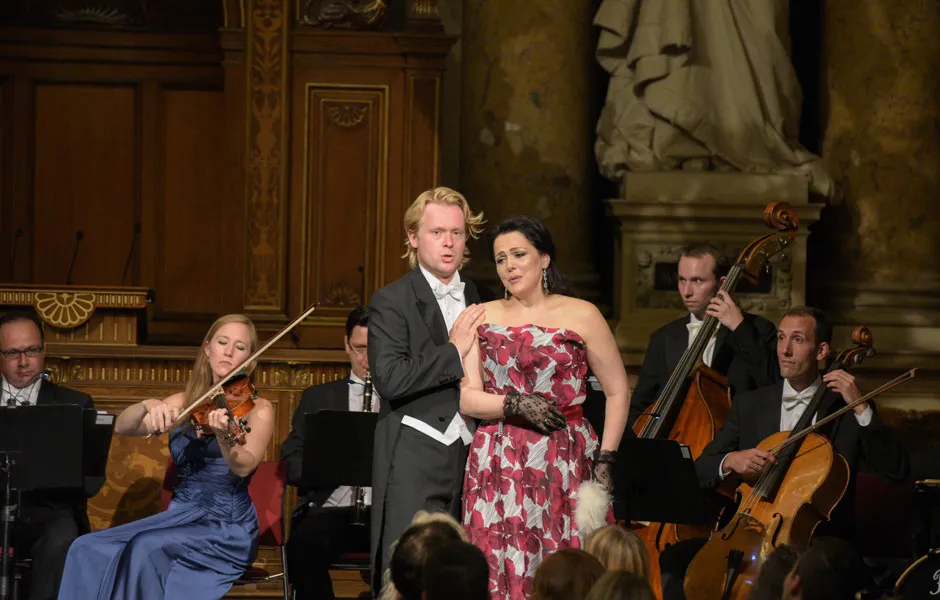
In short
- Two halves with one interval: Mozart, Vivaldi and Schubert first, the Strauss family after.
- Most pieces last a few minutes rather than half an hour; the Blue Danube closes the evening.
- The same programme plays every night, arranged by concertmaster Michal Hudak. Single works can change.
Before the interval
- Wolfgang Amadeus Mozart, 1756–1791
The Marriage of Figaro, overture
Le nozze di Figaro, K. 492First heard at the Burgtheater in Vienna in 1786. In about four minutes it races through the whole mad day of the opera that follows, which makes it the classic way to open an evening.
- Francesco Cilea, 1866–1950
“Io son l’umile ancella”
I am the humble servant, from Adriana LecouvreurAn aria from 1902. A great actress of the Comédie-Française says she is only the servant of her art.
- Antonio Vivaldi, 1678–1741
The Four Seasons, a selection
Four violin concertos printed in 1725, each with a poem about its season: birdsong in spring, a storm in summer. Vivaldi died in Vienna in 1741.
- Wolfgang Amadeus Mozart
Eine kleine Nachtmusik
A Little Night Music, K. 525Finished in Vienna on 10 August 1787, while Mozart was writing Don Giovanni.
- Franz Schubert, 1797–1828
Moments musicaux
Musical Moments, D. 780Short piano pieces printed in Vienna in 1828, the year Schubert died, at 31.
- Johann Strauss II, 1825–1899
Morning Papers, waltz
Morgenblätter, Op. 279Written for the 1864 ball of Concordia, the Vienna press club, as a reply to Offenbach’s waltz Evening Papers.
- Johann Strauss II
New Pizzicato Polka
Neue Pizzicato-Polka, Op. 449From 1892. The strings put their bows down and pluck every note.
- Johannes Brahms, 1833–1897
Hungarian Dance No. 5
Written for piano four hands and the best known of Brahms’s twenty-one Hungarian Dances. It speeds up and slows down without warning.
After the interval
- Johann and Josef Strauss
Patriotic March
Vaterländischer MarschA march the two brothers wrote together.
- Paul Lincke, 1866–1946
Winter Landscape, and Fritzi and Fritze
Winter-Landschaft; Fritzi und FritzeTwo light pieces by the father of Berlin operetta.
- Luigi Arditi, 1822–1903
Il bacio
The KissA waltz song from 1860, written as a showpiece for the soprano Marietta Piccolomini.
- Johann Strauss II
Thunder and Lightning, polka
Unter Donner und Blitz, Op. 324A fast polka from 1868: the timpani are the thunder and the cymbals the lightning.
- Michal Hudak
Tango medley
The concertmaster’s own arrangement of Leroy Anderson’s Blue Tango and music from Verdi’s La traviata.
- Johann Strauss II
The Blue Danube
An der schönen blauen Donau, Op. 314First heard in Vienna in 1867 and now the city’s unofficial anthem. It is also the traditional encore of the Vienna New Year’s Concert.
Sources: The orchestra’s own programme; first performances and dates from the composers’ catalogues.