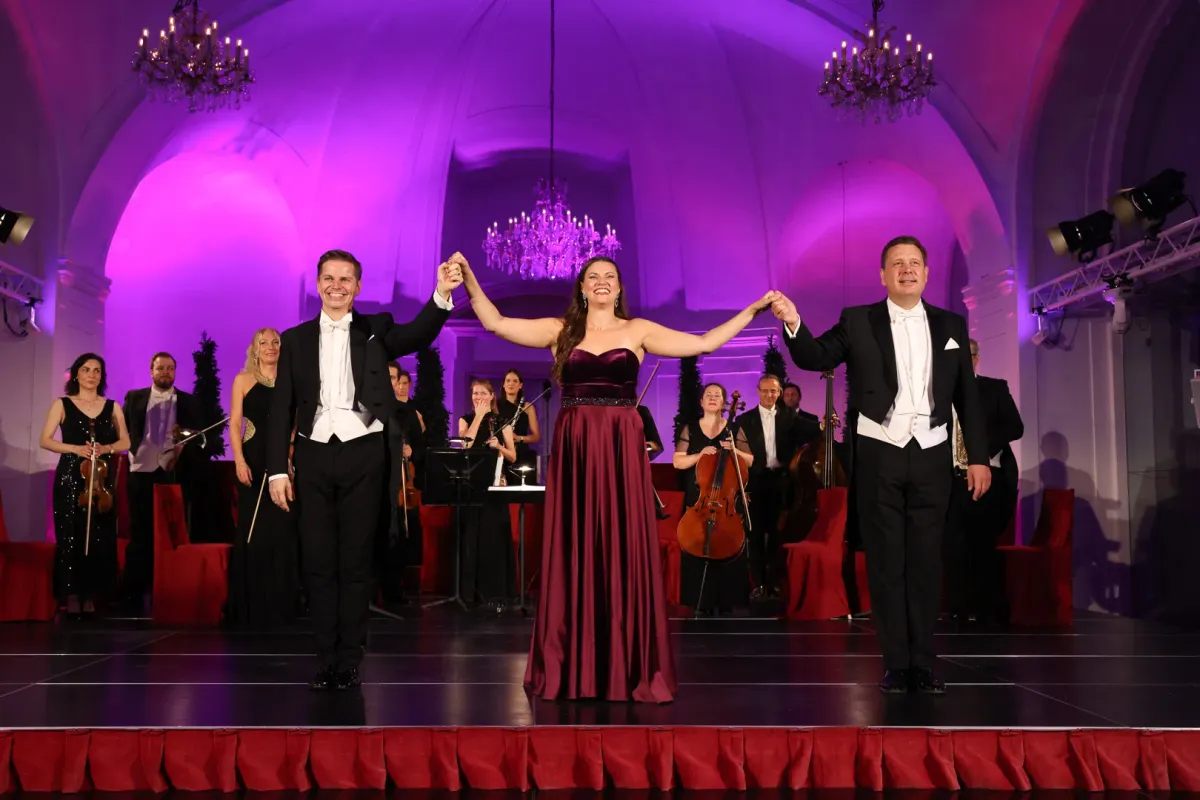
In short
- About an hour and forty-five minutes, with an interval of fifteen minutes.
- Each evening is chosen from this repertoire, so single works change from night to night.
- The evening ends with the Blue Danube and the Radetzky March.
Before the interval: Mozart
- Wolfgang Amadeus Mozart, 1756–1791
The Marriage of Figaro: overture and two duets
Le nozze di Figaro, K. 492First heard at the Burgtheater on 1 May 1786, three months after Mozart’s evening in this Orangery.
- Wolfgang Amadeus Mozart
The Magic Flute: overture, Papageno’s song and the “Pa-pa-pa” duet
Die Zauberflöte, K. 620The last of Mozart’s operas to reach the stage, in 1791, at a theatre in the Vienna suburbs, with its librettist singing Papageno.
- Wolfgang Amadeus Mozart
Don Giovanni: arias and the duet “Là ci darem la mano”
Don Giovanni, K. 527In the Catalogue Aria the servant Leporello counts his master’s conquests country by country: in Spain alone, a thousand and three.
- Wolfgang Amadeus Mozart
The Impresario, overture
Der Schauspieldirektor, K. 486Written for the evening of 7 February 1786 in this Orangery, when Joseph II set it against an opera by Salieri.
- Wolfgang Amadeus Mozart
Così fan tutte: “Come scoglio” and a duet
Così fan tutte, K. 588Fiordiligi swears to stand as firm as a rock; the next act proves otherwise.
- Wolfgang Amadeus Mozart
A symphony movement, and the minuet of Eine kleine Nachtmusik
Chosen for the night, for example from the “Haffner”, the “Linz”, the “Prague” or the Symphony No. 40.
After the interval: the Strauss family
- Johann Strauss II, 1825–1899
Die Fledermaus: overture and two songs
The BatThe operetta of a Viennese New Year’s Eve, first heard at the Theater an der Wien in 1874.
- Johann Strauss II
The Gypsy Baron: overture and Zsupán’s song
Der ZigeunerbaronA pig farmer boasts that he never learnt to read, in the operetta of 1885.
- Johann Strauss II
Waltzes such as the Emperor Waltz, Voices of Spring and Viennese Blood
Kaiserwalzer, Frühlingsstimmen, Wiener BlutChosen for the night from the family’s waltzes.
- Josef Lanner, 1801–1843
The Schönbrunn Waltz
Die Schönbrunner, Op. 200Named after the palace, by the friend and rival of Johann Strauss I.
- Johann Strauss II
Polkas: Chit-Chat, Champagne, Thunder and Lightning
Tritsch-Tratsch, Champagner, Unter Donner und BlitzFast dances of a few minutes each; the Champagne Polka has its popping cork.
- Johann Strauss II
The Blue Danube
An der schönen blauen Donau, Op. 314First heard in Vienna in 1867, and the city’s unofficial anthem since.
- Johann Strauss I, 1804–1849
Radetzky March
Radetzky-Marsch, Op. 228Written in 1848, and the march that ends the Vienna New Year’s Concert, the audience clapping along.
Sources: The orchestra’s own published repertoire; the history of each work from the standard reference works.