In short
- Nicola Pacassi built the Orangery for Franz I Stephan around 1754: 189 metres long, longer than the palace itself.
- On 7 February 1786 Joseph II had a short opera by Mozart and one by Salieri played here on one evening.
- A few nights a year are in the palace, in the Great Gallery or the White-and-Gold Room; each date names its room.
A house for orange trees
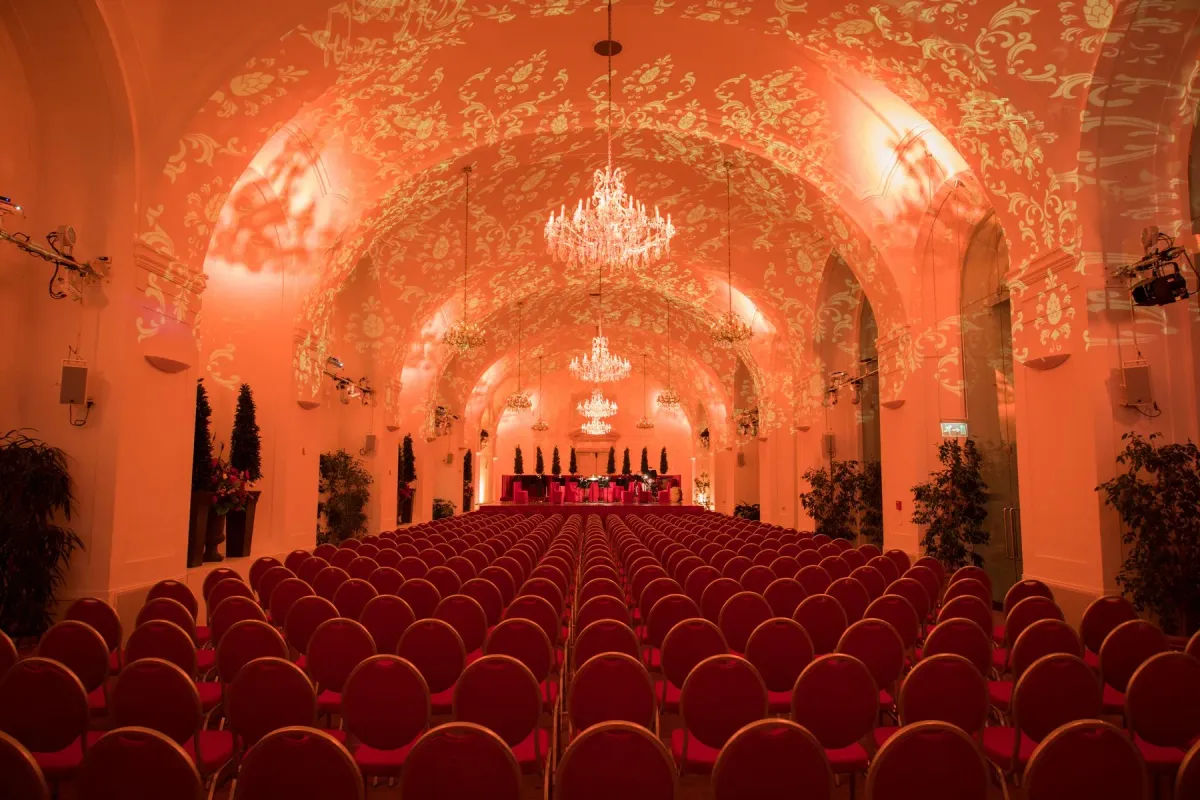
In the Baroque, citrus trees were a princely luxury, and an orangery kept them through the northern winter. Schönbrunn’s, about ten metres wide and 189 long, is the largest Baroque orangery after the one at Versailles, and it is still heated through its floor: look for the dark plates you walk over.
The emperor’s winter feasts
Joseph II filled the hall in winter with tables among the flowering trees and lights in their branches. On 7 February 1786 a stage stood at each end: Mozart’s Der Schauspieldirektor was played first, then Salieri’s Prima la musica e poi le parole, both comedies about putting on an opera. No winner was named, but Salieri was paid a hundred ducats and Mozart fifty.
During the Congress of Vienna, on 11 October 1814, princely guests dined here under 28,000 lamps.
The hall today
A glass wall now divides the long hall: the part towards the palace is a greenhouse again, the part towards the Meidling gate is the concert hall, with its bar. With the palace and its gardens, the Orangery has been part of a UNESCO World Heritage Site since 1996.
The Great Gallery
The palace’s ceremonial hall, more than forty metres long, with tall windows, crystal mirrors, white-and-gold stucco and ceiling frescoes by Gregorio Guglielmi. Court balls and banquets were held here, and on 3 June 1961 John F. Kennedy and Nikita Khrushchev met in it.
The White-and-Gold Room
A Rococo room of Maria Theresa’s time on the palace’s ground floor, panelled in white and gold. Its new parquet follows fragments of the original floor found during restoration. It is the smallest of the three rooms, and its door is the palace’s main gate, not the Orangery.
Sources: The organiser’s own history of the Orangery and its venue pages; the UNESCO World Heritage List; standard reference works on the two operas.